
Concussion of the brain (Sports related concussion)

Anatomy

The brain is surrounded by the meninges and protected by the skull bone.

Cause

A direct blow to the head, if the head hits something hard or if the head is moved suddenly and forcefully, sports activities can cause violent tremors where the brain hits the skull bone with such force that a concussion occurs. In severe cases, there is fluid extraction and bleeding in the brain or on the surface of the brain.

Recent studies have shown that even mild head trauma can cause long-term effects (Cancelliere C. et al., 2023).

Autopsy studies have shown an increased incidence of neuropathological changes in the form of protein deposits in the brain among athletes in contact sports such as American football, rugby and soccer many years after they have stopped playing. (Mackay DF, et al. 2019)

Similar protein deposits are also seen in neurodegenerative diseases such as Parkinson’s disease and Alzheimer’s dementia.

Symptoms

Headaches, dizziness, memory problems, sensitivity to light and sound, mood swings, difficulty concentrating, general malaise, nausea, visual disturbances, drowsiness increasing to remoteness, unconsciousness, seizures and in the worst cases death. In the rare cases where fatalities have occurred in sports following blows to the head, this often happens if two head injuries occur in the same match.

In the very rare cases where fatalities have occurred in sports after a blow to the head, this often happens if 2 head injuries occur in the same match. 10-30% of athletes with concussion experience persistent symptoms (i.e. adults for more than 2 weeks and children for more than 4 weeks). In the vast majority of cases, a concussion heals within the first few weeks.

Examination

Any athlete who suffers a blow to the head and subsequently complains of feeling unwell should immediately stop the sporting activity and be examined by a healthcare professional. (Register-Mihalik JK, et al. 2019). In cases of loss of consciousness, loss of awareness or balance problems, the athlete should be removed from the field and assessed by a doctor or other authorised medical professional and should not return to sporting activity on the day of the injury. If a ‘sideline assessment’ does not indicate a concussion, a medical professional can assess whether the athlete can continue sporting activity. If the athlete is allowed to continue, a follow-up assessment must be made to determine if there is a delay in the development of symptoms.

If no doctor or other medical professional is present, and if the suspicion of concussion persists, the athlete should be assessed at the local hospital.

For symptoms over 2 weeks in adults and 4 weeks in children, referral for targeted assessment and treatment by healthcare professionals with experience in concussion management and neuropsychological examination is advised. Minors are more vulnerable to concussion as it coincides with periods of brain-motor maturation and development.

All head injuries should be taken seriously, as in some cases, life-threatening bleeding or chronic damage can occur. However, the majority recover 100% within a few weeks, with only 30% of adults experiencing symptoms for more than 2-3 weeks and children and adolescents for more than 4-6 weeks.

Treatment

In the event of an acute head injury, the primary focus must be on potentially life-threatening conditions such as cerebral haemorrhage, seizures and fractures of the skull or spine, and acute treatment must be directed towards these, including calling for the relevant emergency medical assistance to manage these conditions.

For non-emergency treatment needs, rest and relief and avoidance of physical and cognitive (thinking) activity until symptoms have subsided is advised. Taking painkillers to continue sporting activity is discouraged and may be risky.

Before physical activity can be resumed, there must be no remaining physical, cognitive or emotional symptoms, or sleep disturbances. It is advisable to avoid alcohol and caffeinated drinks.

By gradually increasing the level of activity, the goal of returning to normal daily activities is achieved for the vast majority of adults within two weeks and for children within four weeks.

The strongest predictor of how quickly symptoms resolve following a sports-related concussion is the severity of the symptoms in the first few days after the injury. Few symptoms on the first day after the injury are a favourable prognostic indicator.

Rehabilitation, specific:

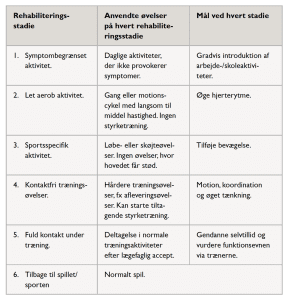
Rest and take it easy for 1–2 days. After that, training can be gradually resumed as shown in the diagram, provided the symptoms do not worsen. There should be at least 24 hours between each of the 6 steps.
In particular

More widespread use of helmets in different sports will undoubtedly reduce the number of concussions and their consequences.

Rehabilitation