
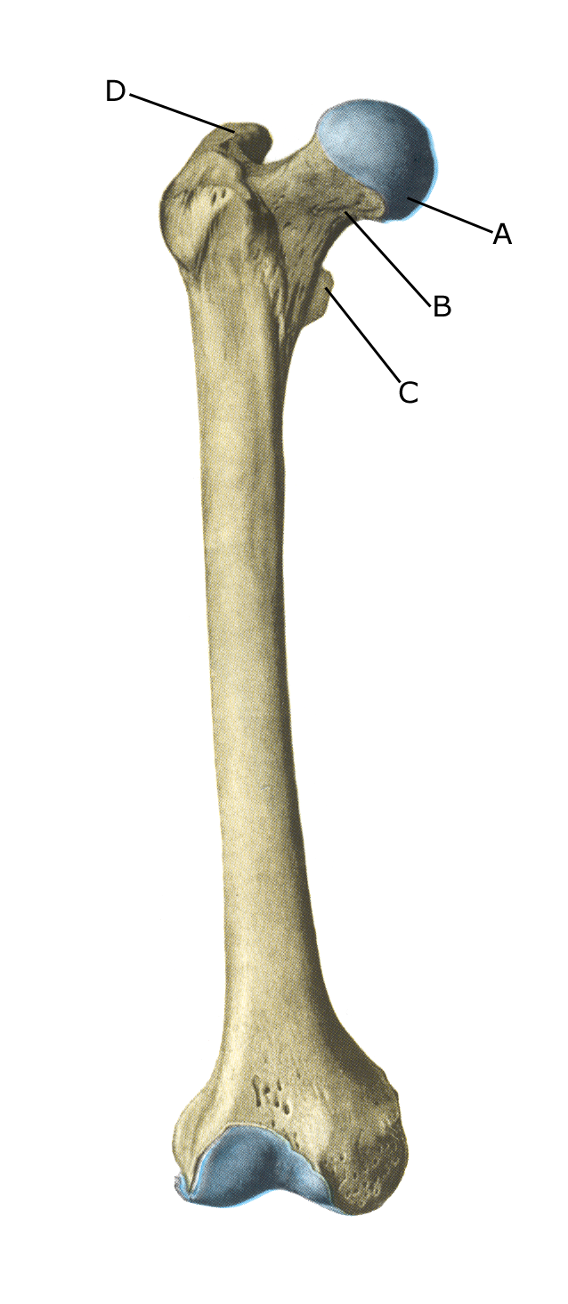
Anatomy
The hip joint consists of the hip socket (acetabulum) and the head of the femur (caput femoris). This is attached to the neck of the femur (collum femoris). Between the head of the femur and the neck of the femur lies the growth plate (epiphysis).
Femoral head
A. Caput femoris
B. Collum femoris
C. Trochanter minor
D. Trochanter major
Cause
The cause of femoral head slippage during the growth spurt is unknown, but it is more common in overweight individuals. The condition most commonly affects boys aged 11–16. Boys are affected twice as often as girls. Nearly half of all cases are bilateral.
Symptoms
There is usually no trauma, and initially there is often only mild pain and fatigue in the hip. Later, the pain worsens and is triggered by movement and weight-bearing. There is often a limp and, very frequently, restricted rotation in the hip joint.
Occasionally, the pain is felt in the knee, groin and thigh instead. Unprovoked knee pain in young teenagers therefore raises suspicion of epiphysiolysis of the hip.
Examination
It is important to see a doctor and receive a diagnosis as soon as possible, as this is crucial to a successful outcome of treatment. During the examination, your gait and hip rotation will be assessed.
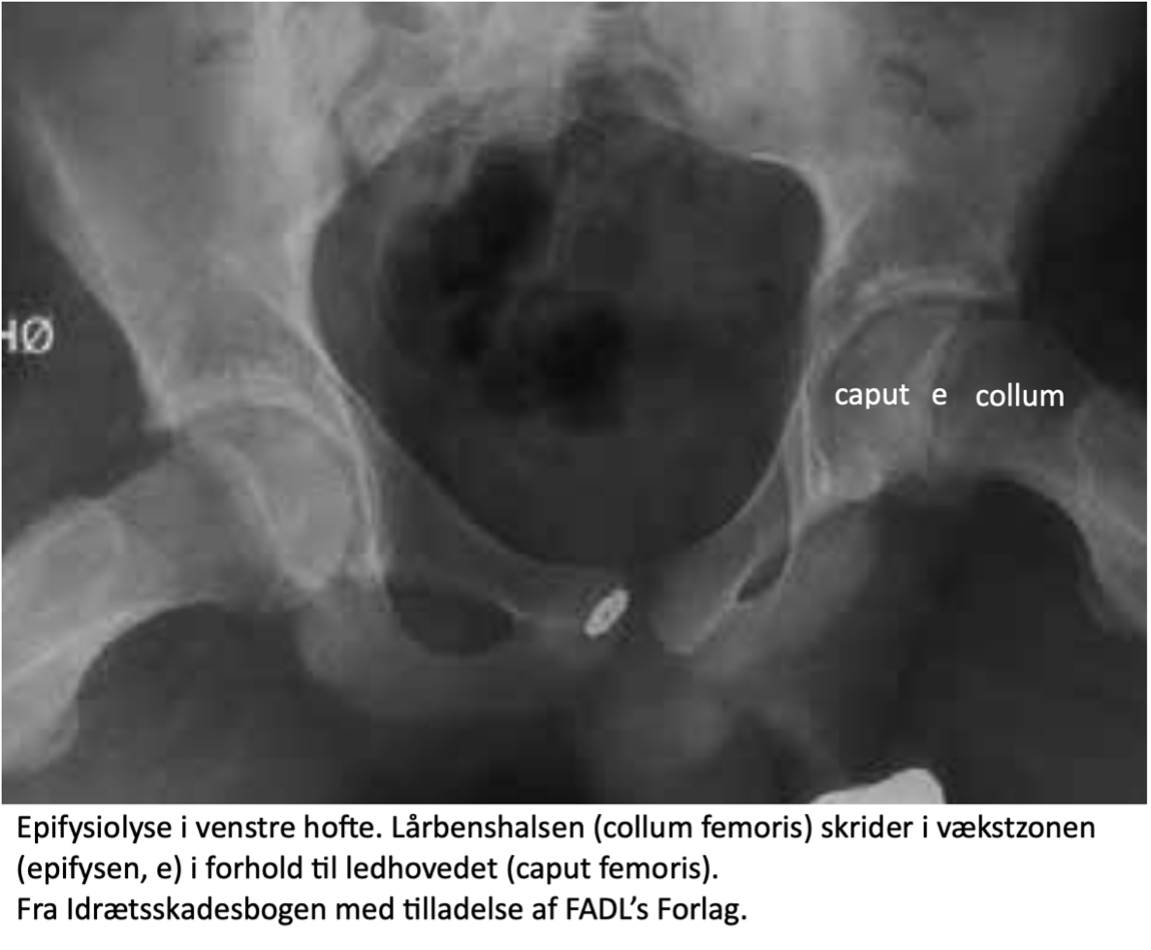
If epiphysiolysis is suspected, the standard clinical examination must be supplemented immediately with X-rays of both hip joints, including oblique views (Lauenstein’s projection) (see X-rays for epiphysiolysis). As X-rays may fail to detect the earlier stages of epiphysiolysis, it may be necessary to supplement the examination with ultrasound and MRI scans.
Treatment
Behandlingen bør starte hurtigst muligt og er primær aflastning, som bør starte allerede ved mistanken. Mere end 80% har behov for operation, hvor ledhovedet operativt sættes på plads og fikseres (Panuccio E, et al. 2022).
Rehabilitation
The amount of exercise and rehabilitation that can be allowed is entirely dependent on the severity and treatment of the disease, which is why all rehabilitation should be done in close co-operation with the doctors controlling the treatment.
Complications
The prognosis depends on the degree of slippage, but most patients have a good prognosis. The condition carries a risk of permanent damage to the femoral head (caput necrosis), along with osteoarthritis of the hip joint, as well as leg shortening and reduced mobility in the hip joint. If there is no improvement, one must consider whether the diagnosis is correct.
In particular, you need to consider
- Bacterial infection of the joint (pyarthrosis)
- Fluid build-up in the hip joint
- Calve-Legg-Perthes disease
- Inflammation in the growth zone of the ischial tuberosity
- Betændelse i vækstzonon omkring hoften
- Inguinal hernia
- Bone disease (Yagdiran A, et al. 2020).