
inflammation of the holloway foot tendon/fasciitis plantaris

Anatomy

The calf muscles attach via the Achilles tendon to the back of the heel bone (calcaneus). The plantar fascia (aponeurosis plantaris) originates from the heel bone on the sole of the foot and attaches to all five toes. The plantar fascia helps to maintain the longitudinal arch of the foot.
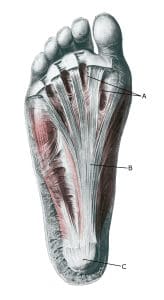
The growth plate on the heel bone extends from the back of the heel bone, where the Achilles tendon attaches, to the underside of the heel bone, where the plantar fascia attaches.

Sole:

A. Aponeurosis plantaris
B. Tuber calcanei

Cause

Inflammation at the point where the plantar fascia attaches to the heel bone is typically seen in children aged 8–12. It is caused by inflammation in the growth plate of the heel bone, which occurs as a result of repeated strain from running and pushing off.

As the plantar fascia is a functional extension of the Achilles tendon, the stresses that lead to overuse injuries at the insertions of the plantar fascia and the Achilles tendon are often the same. Inflammation of the plantar fascia insertion on the heel bone is often seen in combination with inflammation of the Achilles tendon insertion on the heel bone (Mb Sever) ( Kothars EA. et al., 2023 ).

Symptoms

Pain when running and pushing off, as well as pressure on the plantar fascia insertion just below the heel bone. The pain is usually most pronounced slightly on the inside (medially) of the insertion.

Examination

The diagnosis is usually made during a routine clinical examination, during which the characteristic pain can be elicited by applying pressure beneath the heel at the point where the plantar fascia attaches to the heel bone. However, the severity of the tenderness is not always an indication of the extent of the injury. If you experience more severe tenderness or sudden onset of pain, it is advisable to see a doctor to rule out conditions such as a broken bone in the foot and to ensure a correct diagnosis and treatment.

If there is any doubt about the diagnosis, X-rays, ultrasound scans and, if necessary, an MRI scan may be carried out, particularly in cases of sudden, severe pain and suspected tendon tear (which X-rays often fail to detect). An ultrasound scan can be used to assess any inflammation in the tendon.

Treatment

Treatment primarily involves avoiding activities that trigger pain (such as running), stretching, and gradually increasing rehabilitation within the pain threshold.

If treatment is started promptly, the injury may in some cases heal within a few weeks. If the pain has been present for several months before rest is prescribed, a rehabilitation programme lasting several months (six months) is often to be expected. Running shoes with shock-absorbing heels are recommended.

Injections of adrenal cortex hormones or surgery are not indicated in children.

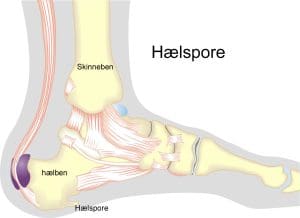
Heel spur

“Inflammation” (plantar fasciitis) of the plantar fascia is sometimes associated with a heel spur. A heel spur is a bony growth that develops as a result of prolonged, strain-induced “inflammation” at the point where the plantar fascia attaches to the heel bone.

A heel spur is therefore a consequence of the overuse injury, not the cause of it. Once a heel spur has formed, it will never disappear. A heel spur has no practical significance and does not require treatment. Many asymptomatic athletes have a heel spur without having experienced any symptoms from the plantar fascia.
Bandage

There is limited evidence to support the effectiveness of taping for plantar fasciitis, but it is worth trying as the tape does no harm if applied correctly; see tape 1 and tape 2

Complications

If the process is not progressing smoothly, the following should be considered:

In particular

It is absolutely essential to act at the first sign of soreness or pain, so that the training programme can be adjusted and the duration shortened.

Rehabilitation

Rehabilitation program