
Anatomy
The joint capsule beneath the metatarsophalangeal joint (MPJ) is reinforced by a fibrocartilaginous (connective tissue/cartilage) connective tissue plate (known as the plantar plate or volar plate), which helps to stabilise the joint.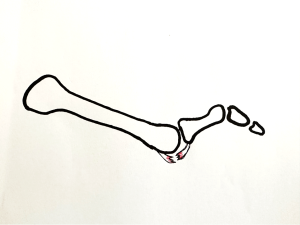
Cause
Repetitive stress (e.g. running with sudden stops and changes of direction) or if the toe is bent sharply backwards (hyperdorsiflexion) places excessive strain on the plantar plate, which may eventually rupture, causing the metatarsophalangeal joint of the big toe to become unstable.
Der kommer ofte hævelse (ødem) under tåen. Arvævsdannelse (pericapsulær fibrosis) ses meget hyppigt i ledkapslen ved skader på plantar-pladen (Mann TS, Et Al. 2022). Skaden ses hyppigt på kunststofbaner (hvorfra navnet Turf-toe stammer). Skader på plantar-pladen er en hyppige og ofte overset skade.
Symptoms
Sudden or, more commonly, gradually developing pain under the big toe, which worsens with weight-bearing. A significant proportion of patients have experienced pain for several months before seeking help (Mann TS, Et Al. 2022). The pain may progress to the point of becoming debilitating for sporting activities.
Examination
The diagnosis is made following a clinical examination by a relevant healthcare professional. Pain is felt when pressure is applied to the base of the big toe, and this worsens when the toe is bent upwards (extended). It is often necessary to supplement this with imaging tests (X-ray, ultrasound or MRI scan). Ultrasound and MRI scans can determine whether the plantar fascia has torn. If the plantar fascia tears, the sesamoid bones are often displaced (proximally) relative to the opposite foot, which can be seen on an ultrasound scan or X-ray.
Treatment
Treatment involves initially avoiding activities that trigger pain, followed by a gradual increase in activity within the pain threshold. It is recommended that shoes with stiff soles, or possibly arch supports, be worn. Braces and tape may be tried.
In cases of inflammation in and around the plantar fascia where rest has not led to improvement, one may consider supplementing treatment with medication in the form of anti-inflammatory tablets (NSAID) or ultrasound-guided injections of Corticosteroids into the inflamed area, although the evidence for this is limited.
In complex cases involving a tear in the plantar fascia, or where symptoms persist despite rest and medical treatment, surgery may be indicated; however, surgery is performed in only around 2% of cases (Najefi AA. Et al. 2018 ).
Rehabilitation, specific
Exercise within the pain threshold is permitted. General guidelines for rehabilitation should be followed. Fitness can be maintained through cycling and swimming.
Complications
However, if the condition does not improve steadily, you should consider whether the diagnosis is correct or whether complications have arisen:
Arthritis of the big toe joint (e.g. osteoarthritis, gout),
Sesamoid bone pain under the big toe,
Fracture
Stiffness of the big toe (hallux rigidus)
Tendinitis