
Anatomy
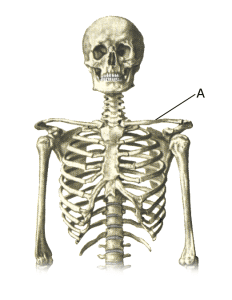
The clavicle (clavicle) forms a joint with the sternum and the upper bony prominence of the shoulder blade (acromion). Among other things, the clavicle serves as the attachment for many shoulder and chest muscles.
Skeleton:
A. Clavicle
(clavicle, collarbone)
Cause
A direct fall on the shoulder or outstretched arm or direct trauma can cause a fracture of the collarbone, which is one of the most common fractures (5-10% of all fractures). The fracture usually occurs in the centre of the collarbone. The ligaments that hold the clavicle in place can also break during the fracture
Symptoms
Pain in the area of the collarbone, which worsens with movement of the shoulder joint. In cases of a displaced fracture, a bulge can often be seen on the collarbone.
Examination
Sudden onset of severe shoulder pain with restricted movement after a trauma should always lead to an examination by a professional. X-rays can usually show the fracture and determine treatment based on the type of fracture.
Treatment
Depending on the type of fracture, you may choose to rest the arm and, if necessary, wear a sling for a short period until the pain subsides after a couple of weeks at most. You may move your arm freely as long as it does not cause pain. Heavy lifting should be avoided for the first 6 weeks.
For more complicated displaced fractures in adults, many choose to surgically stabilise the fracture, resulting in a quicker return to sport, although the scientific evidence is limited (Markes AR, et al. 2022). Children are usually treated with offloading and rehabilitation alone (Vargas-Vila MA, et al. 2019)
Rehabilitation
Once the pain has subsided (often after a few weeks), you can start cardio training in the form of running and rehabilitation according to the guidelines under rehabilitation, general.
After 4-6 weeks, you can start gentle muscle training of the shoulder muscles. After a few months at the earliest, you will be able to participate in contact sports (faster in children than adults).
Combinations
In the vast majority of cases, the fracture heals without complications. However, some people experience long-term discomfort following a clavicle fracture, even though the fracture has healed. Some fractures result in the formation of a false joint (pseudoarthrosis), which requires (further) surgery. The collarbone protects major blood vessels, lung and nerve centre.
In rare cases, a clavicle fracture can cause damage to these structures, requiring emergency hospitalisation.