
Anatomy
The hip joint consists of the hip socket (acetabulum) and the head of the femur (caput femoris). The joint surfaces are covered by a layer of cartilage a few millimetres thick, which reduces the stress on the joint surfaces. In some cases, the osteoarthritic changes can lead to an ‘inflammation’ of the synovial membrane (synovitis), which causes fluid formation, swelling, restricted movement and pain in the hip joint.
Cause
Many minor repetitive strains or one severe strain can lead to an ‘inflammation’ of the synovium (synovitis), fluid build-up, swelling, restriction of movement and pain in the hip joint.
Fluid accumulation in the hip joint is often caused by osteoarthritic changes, injury to the labrum (labral lesion) or bone growth on the acetabulum and femoral head (caput femoris) that can lead to collision between the acetabulum and femoral head during movement (Pincer and CAM impingement, respectively).
Various inflammatory arthritis diseases can cause joint swelling (arthritis). In rare cases, hip joint swelling can be caused by bacterial infection (pyarthron), which is a serious complication that requires urgent and often surgical treatment.
Symptoms
Pain in the joint when moving under load. There is often a restriction of movement when rotating the hip joint.
Examination
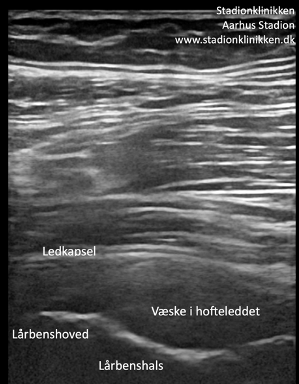
It will often be necessary to supplement the regular clinical medical examination with an ultrasound scan, where the fluid in the hip joint is easily visible.
Treatment
Treatment primarily involves relief from pain-inducing activities until the swelling in the joint has subsided. After this, rehabilitation within the pain threshold can be initiated. If relief is not successful, treatment can be supplemented with medical treatment in the form of arthritis pills (NSAIDs) or ultrasound-guided joint fluid drainage and injection of adrenal cortex hormone.
If the cause is osteoarthritis, labrum injury or Pincer and CAM impingement, surgery may be indicated if symptoms do not resolve with slowly increasing rehabilitation within the pain threshold.
Complications
If there is no progress, you need to consider whether the diagnosis is correct or due to another injury in the hip joint, such as osteoarthritis of the hip joint or damage to the labrum in the hip joint.