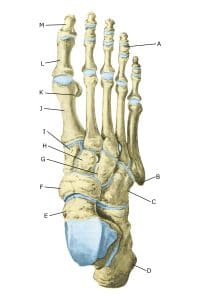
Anatomy
The foot below
A. Ossa sesamoidea
B. Talus
C. Calcaneus
Cause
When a joint is severely twisted, an ‘inflammation’ of the synovial membrane (synovialis) can occur, which thickens and produces more fluid, causing the joint to swell. Fluid accumulation in the joint (traumatic synovitis) is commonly seen as a result of ligament injuries around the ankle and can be caused by damage to the joint, such as cartilage damage.
Fluid accumulation can occur slowly after prolonged overload, for example due to changes in the joint (e.g. osteoarthritis). Increased fluid in a joint thus signals that there is an injury in the joint.
Joint swelling can also be part of a general arthritis condition.
Symptoms
Swelling of the joint. Pain when pressing on the joint lines and with passive and active movement of the joint.
Examination
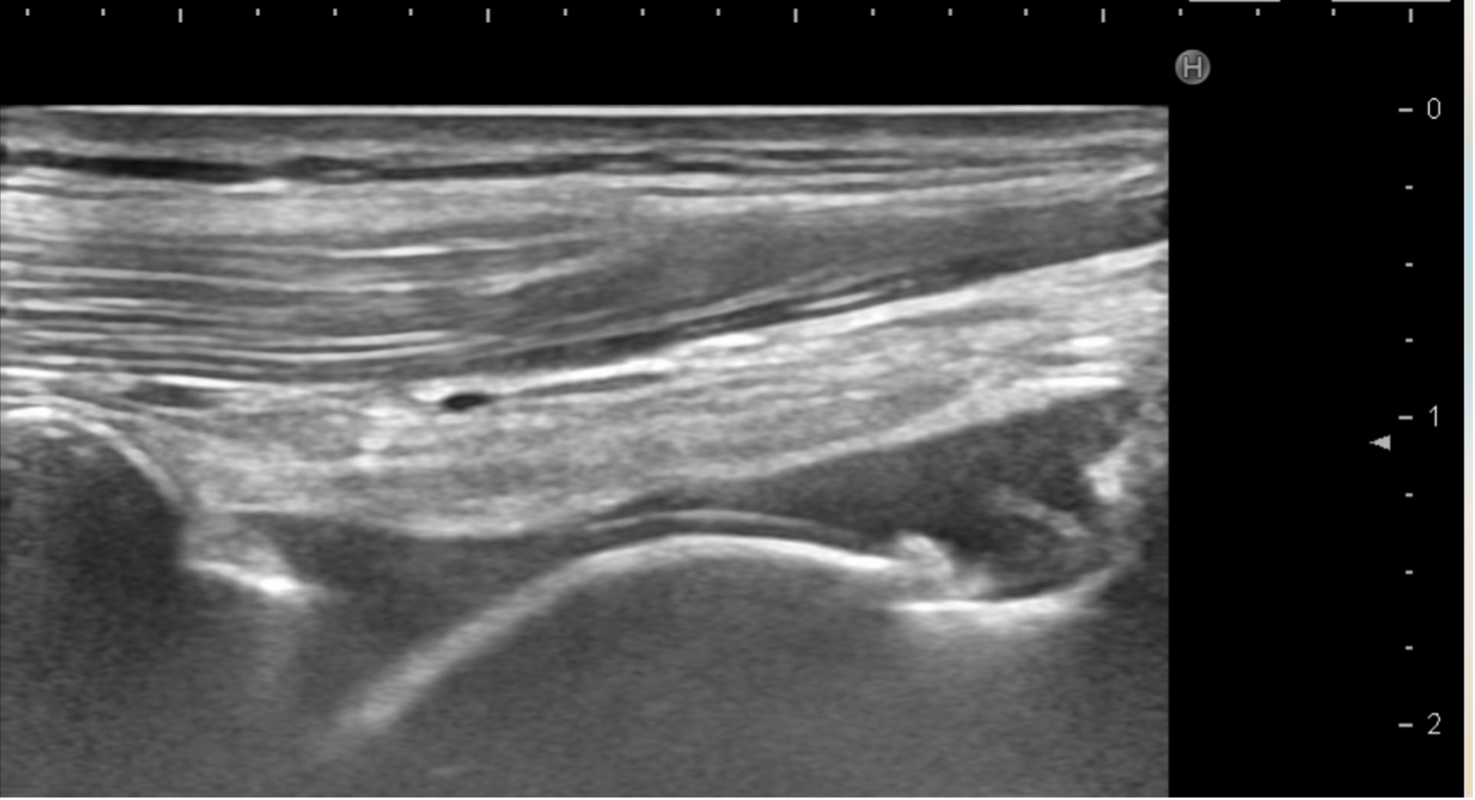
The diagnosis can be difficult to make based on clinical examination alone, but there is often reduced mobility and pain on movement. However, it is often necessary to supplement this with an ultrasound scan, and possibly with X-rays and an MRI scan (Arnold JB, Et al. 2022). Ultrasound scans reveal even minor swelling in the joints, and inflammation within the joint can also be observed
See an ultrasound image of the ankle joint showing increased joint fluid.
Treatment
Treatment primarily involves avoiding activities that trigger pain. If a specific cause can be identified, this should, of course, be treated where possible.
Joint mobility and muscle strength should be maintained without putting strain on the joint, so as not to cause further pain and swelling. Cardio training can be done on a bike or by swimming.
If the joint swelling does not subside despite rest, this can be supplemented with medical treatment in the form of anti-inflammatory tablets (NSAID) or joint aspiration and ultrasound-guided injection of corticosteroids into the joint (Paterson KL, Gates L. 2019). If there is persistent unexplained swelling or pain that does not subside despite relief and medical treatment, additional examinations may be indicated, including an arthroscopic examination (arthroscopy) and possibly surgery.
Complications
Hvis ikke forløbet går jævnt fremad, bør man overveje, om diagnosen er rigtig eller om der er tilstødt komplikationer:
Bone fractures
Tendinitis
Cartilage damage in the joint
Injuries to the outer ligaments of the ankle joint
Injuries to the inner ligaments of the ankle joint